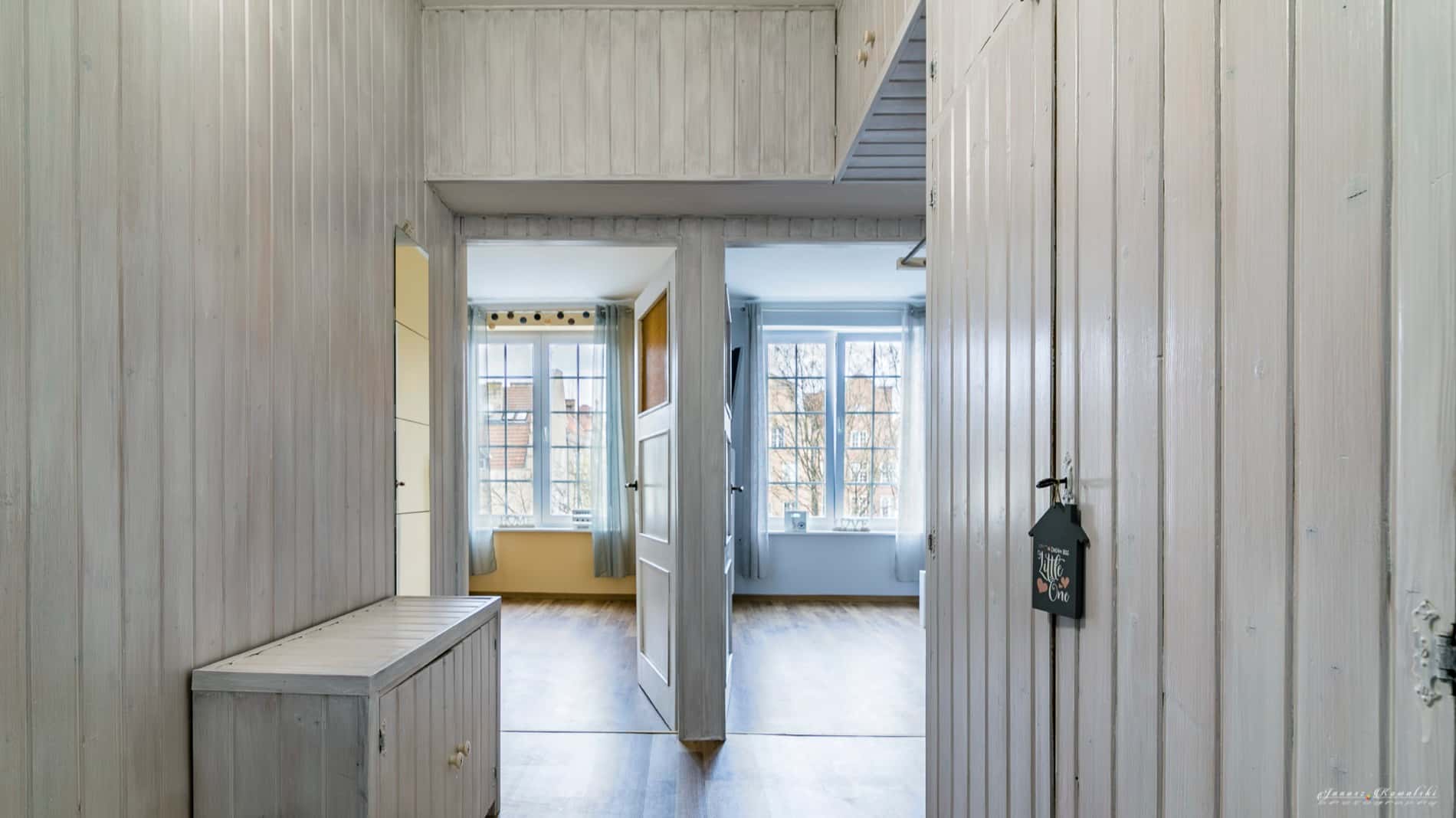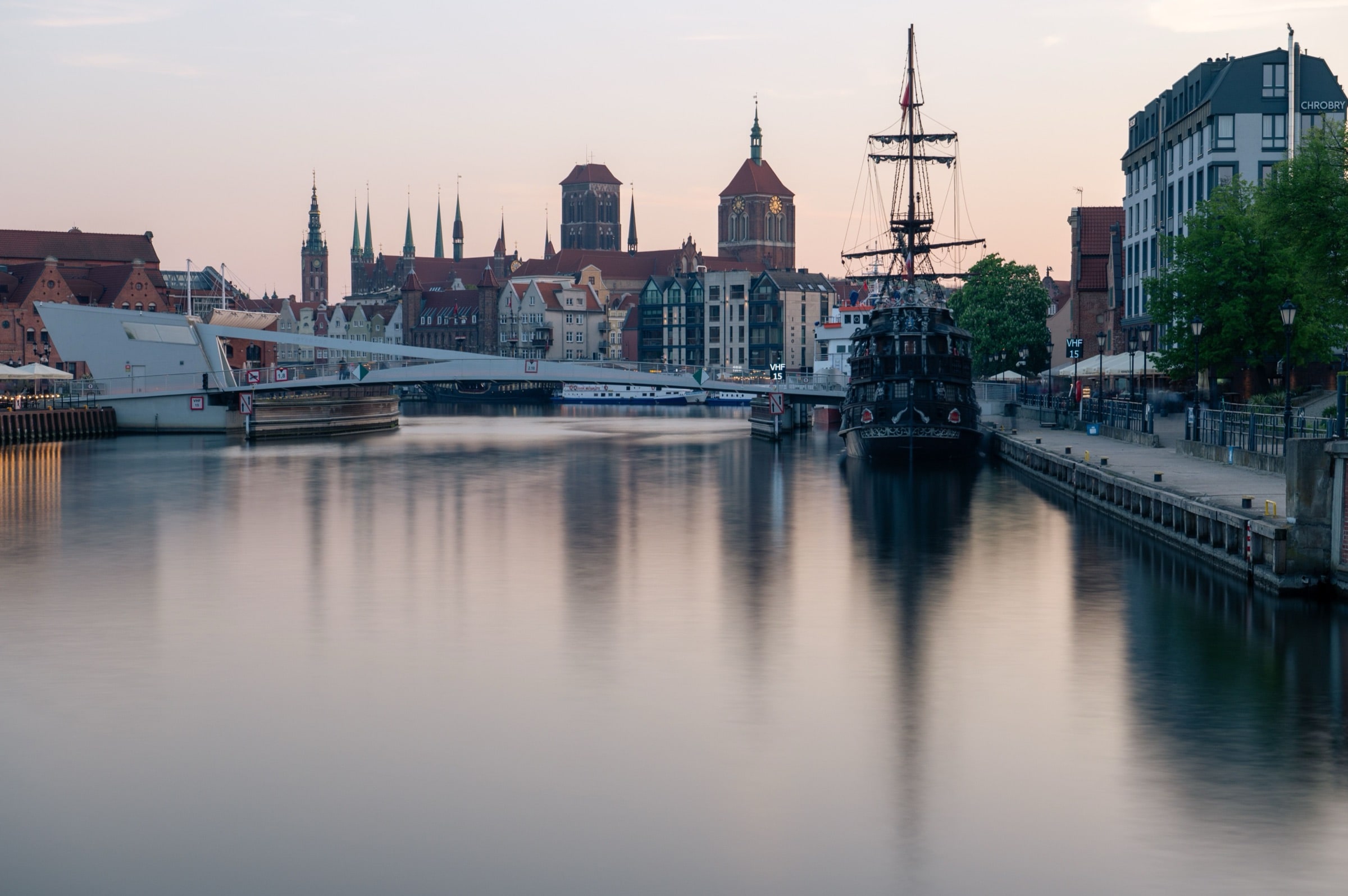
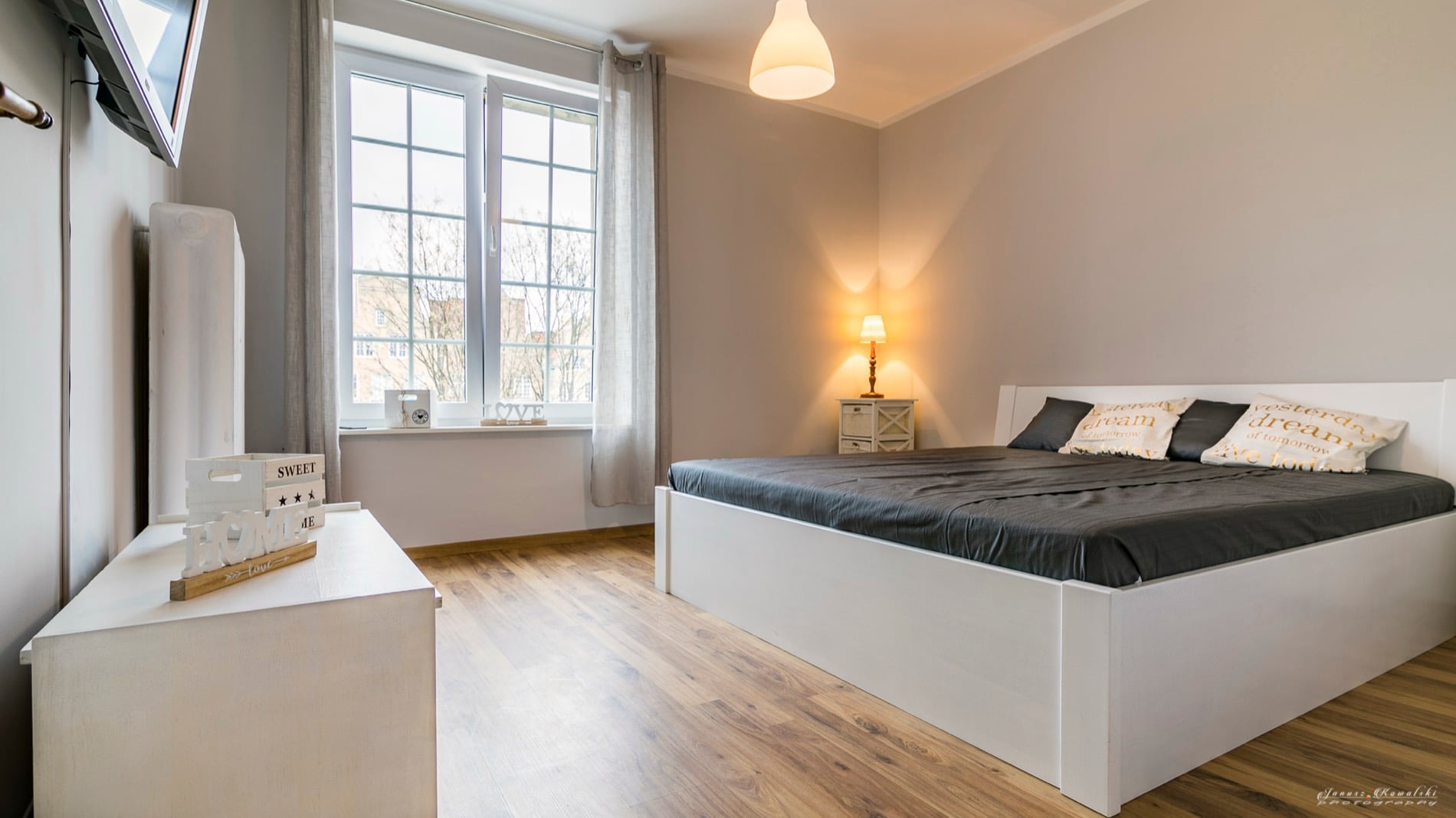
Walk south from the Long Market — ten quiet minutes, give or take — and Gdańsk changes register. The gilded gables thin out, the streets straighten, and water appears on two sides. This is Dolne Miasto, the Lower Town: the quarter where our keys live. The family's own building stands on Toruńska, where the Old Suburb runs into the Lower Town, and guests of ours wake up on these streets. So this note is not a tip so much as an introduction.
The quarter began as flood-meadows on the low ground beside the Motława, taken inside the city in the seventeenth century and kept for generations as a garden quarter — pasture and plots before streets. What made it city was defence: a ring of earthen bastions raised in the Dutch manner along its south and east — Żubr, Wilk, Wyskok, Miś, Królik — with the Opływ Motławy, the surviving arm of the old moat, curving at their feet. And at the ring's far corner stands the Kamienna Śluza, a stone water-gate of the 1620s that let the city flood the fields around Gdańsk until no besieging army could approach. The weapon was water, and the water is still here — today the bastions are grass-covered hills and the moat a green ribbon for walkers and kayaks.
Meadows, then bastions, then factories — and now, slowly, itself again.
The nineteenth century filled the quarter with work — a rifle factory, tobacco works, an oil mill, a garrison — and 1945 emptied much of it. After the war a new through-road cut it off from the centre, and the Lower Town spent decades poor and passed over. The turn came around 2010, when the city began a long revitalization that the European Union now cites as a model of citizen-led regeneration: townhouses, streets and the bastion waterfront renewed in phases, by a coalition of residents, artists and NGOs.
The artists were here early. The 1905 municipal bathhouse on Jaskółcza became the Łaźnia Centre for Contemporary Art in the 1990s, and from 2005 its Outdoor Gallery project planted permanent public artworks — installations, murals, light works — directly into the quarter's streets, on purpose, as part of the renewal. Art here is not something you visit; it is something you pass on the way to coffee.
Be clear-eyed about what you will find. Dolne Miasto is a quarter mid-renaissance, which honestly means scaffolding and the odd fenced site between the renovated façades — street rebuilds still run in phases, and a large private development is working toward 2027. It also means streets the day-trippers haven't found. We would rather tell you both halves of that than either one alone.
The quarter is compact: everything below sits within a few minutes of everything else, along and around Łąkowa.
Give it an unhurried hour: coffee on Łąkowa, the bathhouse gallery, then the moat ring at the end of the day, when the bastion hills hold the last light and kayaks slide along the old defensive water. The Long Market and the amber lanes wait a short, flat walk north. Coming back in the evening, over streets that belong to the people who live on them, you understand what the quarter's slow renaissance is for.